
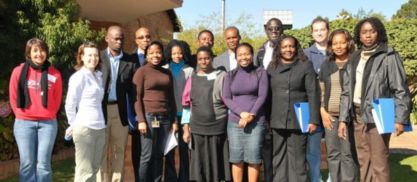
The first PulseNet Africa PFGE training course was held on 2-4th June 2011 at the National Institute for Communicable Diseases (NICD) (www.nicd.ac.za)(external link), Johannesburg, South Africa. The course was kindly sponsored by the WHO Global Foodbourne Infectious Network (GFN) and CDC global Disease Detection Program (GDD).
Trainers included staff from the EDRU, NICD and a staff member (Molly Freeman) from PulseNet USA. Trainees included 9 persons made up of a representative from each of the following countries: Kenya, Senegal, Cameroon, Malawi, Cote d’Ivoire, Ghana, Uganda, The Gambia and Mozambique.
The aims of the course were to teach the technique of PFGE analysis of bacteria, describe how PFGE is the primary genotyping method for international foodborne disease surveillance, and teach the importance of standardized genotyping methods in order to perform inter-laboratory comparison of data and facilitate international investigations. The course focused on Salmonella bacteria and included hands-on practical laboratory training.
The course structure included:
- introduction and overview of PFGE
- equipment requirements
- reagent requirements (including controls and reference standards)
- preparation of equipment and reagents
- performing a PFGE test from start (bacterial culture) to finish (PFGE pattern)
- analysis and troubleshooting of results
- care and maintenance of equipment
- safety requirements
- quality assurance programs